




Regular lawn watering is an extremely important and essential treatment, especially during periods of drought and high temperatures. Only well-watered grass can grow and develop correctly. Therefore, in order to achieve a beautiful, thick and lush green carpet, this maintenance step should not be skipped.
Essentially, grass has a high water requirement, so regular watering can involve significant effort. However, modern gardening offers solutions that greatly improve lawn watering. Each method has its pros and cons, but certain general rules remain common. Simply keep them in mind, and an optimally hydrated lawn will grow beautifully!
Recommendations
Water your newly sown lawn once a day to ensure there is enough water in the soil. This will allow the grass to take root. Once the lawn has been mown three times or is well-established, carry out lawn watering as required. It is best to do this in the morning when water evaporation is less intense. Additionally, you can aerate the soil by spiking the least accessible areas with a fork. In this way, you will help the water reach where it is most needed—the roots.
Usually, lawn watering should be done 2 times a week. When the temperature reaches more than 30 degrees, water as many as 3 times a week. Each time you must provide the lawn with no less than 10 mm of precipitation. The amount of water for a single irrigation is 5-10 litres per 1 m2 of lawn, which gives 1-1.5 m3 for every 100 m2, i.e. 1 are. How to measure this? It is best to check on your meter whether you have poured the appropriate amount of water during watering. If the lawn grows on light or sandy soil, it must receive a minimum of 15 mm of precipitation with each watering.
If, however, there is a layer of thatch on the lawn, the amount of precipitation should be increased to as much as 20 mm at a time. To check the lawn watering levels, try to push a tool such as a screwdriver into the turf. If you can push it in without problem to a depth of 10–15 cm, it means the soil is sufficiently moist. If you are unable to do so, give the lawn a heavy watering immediately.
Additionally, during periods of drought, we advise not walking on the lawn as the grass is dry and brittle. If the lawn requires cutting, do not mow more than once a week or shorter than 50 mm. Furthermore, do not repeat mowing, even if it is clear that the lawn has grown back slightly.
How to perform lawn watering?
Watering by hand
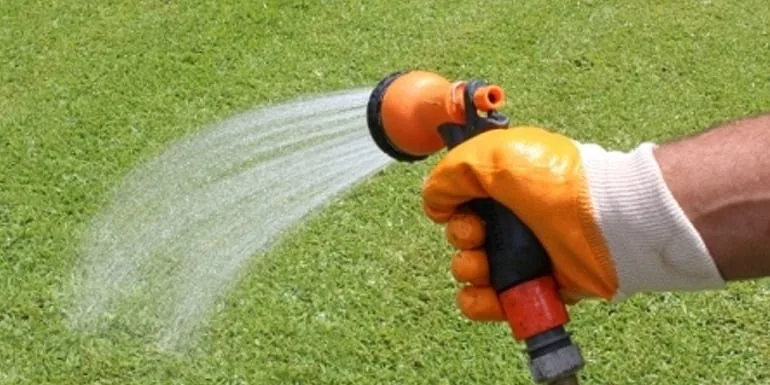
This method is sufficient for lawns up to 50 m2, so it is better suited for watering flower beds or vegetable patches. However, you must ensure that the water from the garden hose is dispersed. Do not use a solid stream! An appropriate hose attachment is enough to achieve a fine mist. The one-off lawn watering time for an area of this size using a garden hose is approximately 15-20 minutes.
This method works best for lawn watering newly sown lawns or after overseeding. It is excellent for washing seeds into the gaps after scarification or aeration. However, it is not suitable for larger lawns, as it would be significantly time-consuming and labour-intensive. Furthermore, manual watering does not ensure an even and appropriately wide spray. Therefore, if you have more than a small lawn, we recommend other, more convenient methods.
Garden sprinklers
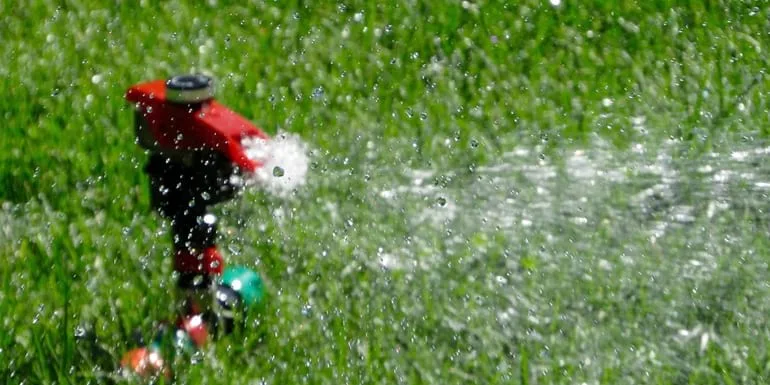
This method of lawn watering is becoming increasingly popular. It is significantly more convenient and less time-consuming than the manual method, and the costs of sprinklers are not high. They are easy to move and simple to operate: just set the appropriate spray range and connect the water source. There are many sprinklers available, with varying operating radii, shapes of the watered area, and water distribution mechanisms.
In the case of this lawn watering method, you will only achieve success when you truly know how much water you have used. How to measure it? It’s simple. Place several empty glasses within the range of the sprinkler and water until at least 10–15 mm of water appears in them. Measure the duration of the watering. Now you know how long you need to water the lawn! Follow these tips every time, and you will certainly see the results.
Automatic lawn watering system
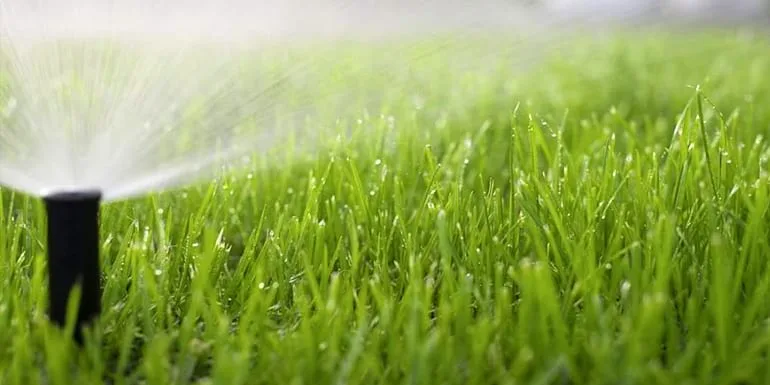
A professional automatic irrigation system is the most convenient option available. Unfortunately, it is also the most expensive method. If you are considering installing such a system, it is best to do so before establishing the lawn. If you make this decision later, it will involve digging through the growing turf. After installing the previously planned system, the controller must be programmed. When set correctly, it automatically activates the sprinklers, which dispense the appropriate amount of water at a specified time.
The key to a beautiful and dense lawn is correct lawn watering. Proper set-up requires knowledge of how large an area each section covers. In most cases, each section is set for 20–30 minutes. However, you cannot always be certain whether this is enough to water the soil to a depth of 10–15 cm. This should be adjusted accordingly, preferably with the help of qualified specialists.
Costs
You have certainly wondered more than once what costs are generated by regular, heavy lawn watering. Contrary to common stereotypes, it is not actually that expensive! Providing a lawn with additional water during one month of the growing season costs approx. £4-6 per 100 m2, which totals approx. £20-30 per year. If you have approx. 200-300 m2, the costs will increase proportionally. As you can see, these are not massive expenses. Especially since a properly watered lawn will be healthier and stronger. This way, you will save money that would have to be spent on “resuscitating” your lawn if it did not receive enough water. As you can see, correct watering is neither difficult nor does it have to be costly, and the results you achieve because of it are priceless!