




Have you ever wondered how to use a spreader for lawn fertilising? If so, this article is for you. In this guide, prepared by experts from Mr. Green Grass, you will learn how to effectively and efficiently distribute fertiliser on your lawn.
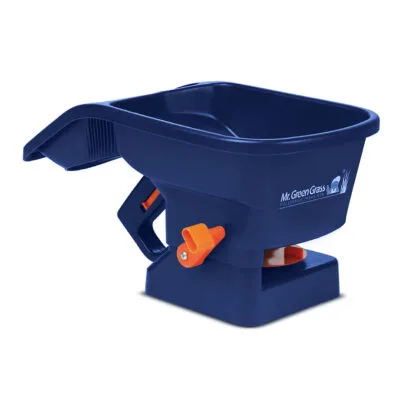
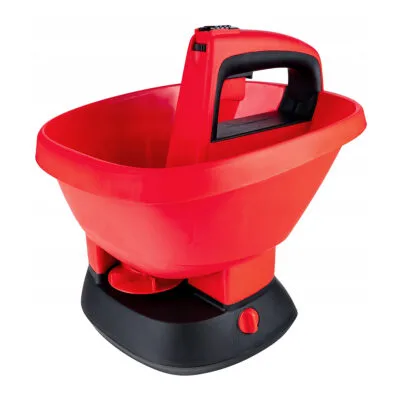
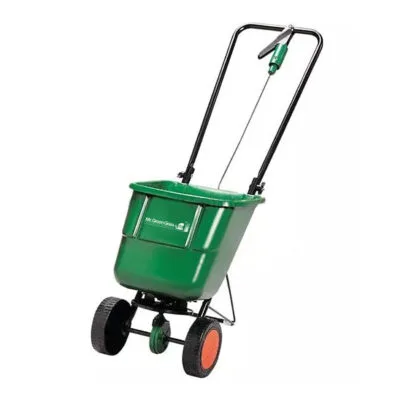
We will discuss two types of spreaders: the hand spreader, ideal for smaller areas up to 400 m², and the broadcast spreader, which works well on larger areas up to 2,000 m². Get ready to gain the essential knowledge that will help you keep your lawn in excellent condition.
Spreading Fertiliser with a Spreader
Above all, never fill the spreader with lawn feed on the lawn – do it on concrete to avoid spilling fertiliser on the grass.
The hand spreader holds 3 kg of fertiliser, which is enough for 100 m² of lawn. To distribute the fertiliser correctly, set the spreader to position number 5 and start fertilising, moving a metre into the lawn. Start turning the handle first, and only then begin fertilising.
Fertilising should be carried out using the cross-application method, setting the spreader to position 5 and fertilising in two directions: lengthwise and crosswise. The hand spreader holds about 3 kg of pH Balancer – Uptake Improvement – Mr. Green Grass®, which is enough for about 50 m² of lawn. Distribute the pH balancer by setting the spreader to position 5. Do this twice, preferably using the cross-application method. Remember that a single dose is 3–4 kg per 100 m².
One spreader holds about 4 kg of Lawn Booster – Moss Killer – Mr. Green Grass®, which is enough for about 100 m². If your moss is very heavy, you should use double this dose. Remember that a single dose of Lawn Booster – Moss Killer – Mr. Green Grass® is between 4 and 8 kg per 100 m². For correct distribution of fertilisers, set the spreader to position 30.
Start walking, then pull the trigger. Walk at a normal pace, without rushing. Before the end of the lawn, first release the trigger and then stop walking. Take two steps and repeat the same in the opposite direction.
Why the spreader is important
The indispensable role of a precisely adjusted spreader is key to effective fertilising. An excessive amount of fertiliser can deprive the lawn of its necessary water supply. The effects of such a situation result in dried blades and areas of damaged grass appearing. If the soil receives too heavy a dose of fertiliser, it will be necessary to devote a lot of time and effort to restoring the nutrient balance. On the other hand, fertilising too sparingly will not achieve the expected effect of a lush green lawn colour, and bare areas without grass may become visible. It is also worth noting that the lawn should be dry during the fertilising process. A mixture of fertiliser and water droplets under the influence of the sun can lead to grass burn.