




One of the fundamental maintenance tasks performed in the garden is lawn mowing. Done correctly, it is a natural way to create a healthy and thick turf. Regular trimming of the lawn to the correct length supports the development of healthy roots. It also helps retain water during dry periods, thereby keeping the grass green for longer.
To achieve the dream effect of a thick, lush green carpet, however, we must follow a few simple rules. Issues such as the height of the cut blades, the frequency of the procedure, the type of mower, and the utilisation of grass clippings are important. After all, improper mowing can do more harm than good!
Correct mowing height and frequency
Many people believe that cutting grass very short prevents rapid regrowth, allowing them to mow less often. In reality, this can only encourage the development of lawn predators such as moss and weeds. Contrary to appearances, mowing “higher” promotes slower grass growth. It should not be mown shorter than 50 mm. Furthermore, never cut more than 1/3 – 1/2 of the total length of the blades.
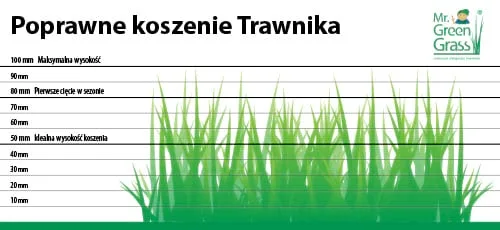
The rules for correct mowing are very simple
To keep the lawn in perfect condition, it is best to mow it twice a week. However, if you have a slow-growing grass species, you can do this once a week. Remember, however, not to neglect this task, as the grass should not be allowed to flower. If it happens that you miss one session and the grass grows too long, do not shorten it radically. It is better to repeat the mowing after 2-3 days than to cut it too short.
Mower type
There are many types of mowers available on the market: manual electric and petrol, lawn tractors, automatic robotic mowers. Traditional models are the most popular. However, the choice of the ideal mower is determined by the area on which it will work. This depends, of course, on the size of the lawn, but also on the budget and user preferences.
Generally, rotary mowers are better for home gardens because they are easier to maintain and work well even on uneven lawns. Cylinder mowers are better for perfectly flat lawns and for more delicate, higher-quality grass.
A universal rule for all mowers is that the blades should be perfectly sharpened. Otherwise, instead of cutting the blades cleanly, they will tear them, and the tips will be dried out, yellowed, and uneven. Furthermore, a blunt blade can pull out less well-rooted clumps.
If you need additional information, be sure to check our article on mower maintenance!
Fertiliser from grass
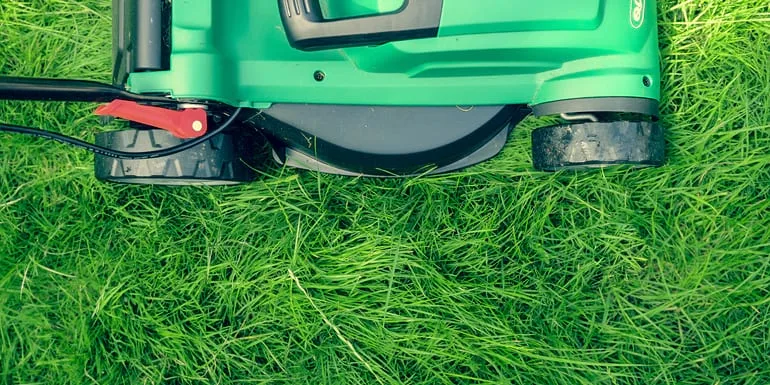
What to do with the grass left over from mowing? Don’t throw it away, but turn it into compost! It is a safe, ecological, and essentially free fertiliser. You can use it to fertilise the lawn, mulch the vegetable garden, or flower beds. Remember not to put grass into the composter immediately after mowing. It is best if it dries for 2-3 days beforehand. It is equally important to layer the composter: alternating layers of wet and dry organic matter. For example, mown grass will be wet matter, while dried leaves, twigs, or straw will be dry. It is also important to ensure proper air circulation for the compost. Therefore, it is worth placing a drainage layer of dry sticks at the bottom of the composter. In compost that is stored for a period of 6-12 months, all herbicide residues will disappear, making the compost safe to use for flower beds or borders.
A good way to use grass clippings is also mulching. However, this works for lawns mown frequently, every few days. The left blades should be young and small so they decompose quickly. Decomposing on the lawn, they constitute a natural and ecological fertiliser. A mower with a set of additional blades for shredding grass is best suited for this purpose.
Our tips
Of course, we have only presented the most important rules above. We will give you a few more tips so that lawn mowing proceeds correctly and safely.