




Uneven grass colour is a problem that appears on many plots or home gardens. Black, yellow or brown patches on the lawn undo the effects of hard work in the garden and spoil the whole effect. The causes of such lawn troubles vary, so you must first determine the source of the problem. This will allow you to introduce appropriate changes in care or apply the best methods. Find out how to eliminate patches on the lawn!
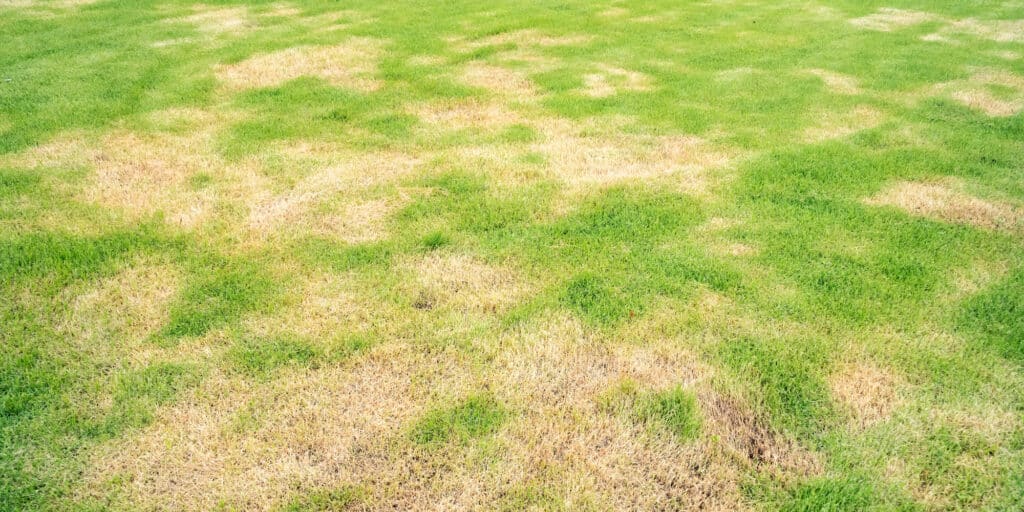
Yellow patches and lawn feed errors
It turns out that you can not only under-fertilise, but also over-fertilise grass. Yellow patches on the lawn are often the result of incorrect fertilisation. In such a case, you should first check the lawn feed packaging to see if you are applying it in the correct doses and intervals. If you are following the instructions but your turf still looks unsatisfactory, it is possible that a change in care will be necessary. Yellow patches on the lawn can also result from spreading fertiliser by hand instead of using a spreader. This causes it to penetrate the soil unevenly. In some places, the grass is intensely green and healthy, while in others it is dry because the fertiliser did not reach there.
Sometimes the opposite situation occurs – the blades have received too high a dose of fertiliser, which did not have time to dissolve and burned dry patches. If the cause of yellow patches on the lawn is over-fertilising, do not apply any lawn feed for several weeks; instead, carry out lawn watering frequently and abundantly so that all the fertiliser dissolves and penetrates the soil.
Black patches on grass
Sometimes a black substrate can be observed beneath the grass blades, and the leaves become covered with a dark coating. If the spots are black or dark brown, you may be dealing with leaf smut, a pests & diseases issue caused by fungi. This is a fungal disease that appears mainly in autumn and spring. The best prevention is proper fertilising, as over-fertilising with nitrogen while omitting potassium and phosphorus creates conditions for this disease to develop. You should also systematically carry out scarification and remove grass clippings.
However, if leaf smut attacks your lawn, the good news is that you do not need to use special medicines or substances for the grass. The smut should disappear when you mow and remove the infected grass, perform lawn scarification, and then take care of the balance of nutrients in the soil itself. Healthy soil means healthy grass – you will get rid of all potential diseases.
Patches on the lawn – what to do?
To get rid of discolouration from the lawn, you must first identify the causes of this condition and eliminate them. If the source of the problems was inappropriate fertilisation, you should change the care accordingly so that it proceeds in the correct way. What should it look like? You will find out from the article on correct fertilisation!
Of course, the causes can be various. If your fertilisation programme is correct, you can improve the overall condition of the lawn by carrying out various maintenance treatments. Scarification and lawn aeration, as well as proper mowing, will certainly help with patches on the grass. Removing surface thatch and grass clippings will limit the possibility of fungal disease development. You will see the effects of these treatments after a few weeks.
A good way to find out what the cause of uneven colour and patches on the lawn might be is to conduct a lawn condition analysis. We offer it to you for free! If you are interested, you can request an analysis by filling out the survey here.