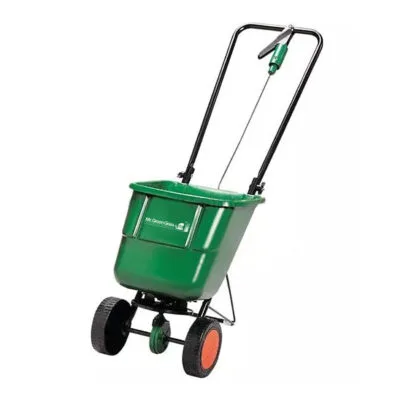

After mowing, the most important yet often neglected care task is applying lawn feed. It is essential for the correct growth and development of plants, as only well-nourished plants will produce the effect of a thick, even, and resilient lawn. Complete fertilising promotes grass tillering, as well as root development.
However, for fertilisation to proceed correctly, we need knowledge not only about the performance of specific fertilisers. An equally important issue is what our lawn needs. Only on the basis of a detailed analysis can the needs of plants for individual nutrients be strictly determined. Fertiliser recommendations are most often attached to the analysis results, and following them gives better results than fertilising “by eye”. How to check this? It is best to send a soil sample to a specialist laboratory. It will then be tested there for the presence of specific substances. Based on the information obtained, the optimal lawn fertilisation can be established.
Lawn Feed — characteristics
Fertiliser recommendations will help you avoid mistakes in feeding your grass, supporting its mineral management. A common mistake is fertilising with only one ingredient – nitrogen. After a temporary improvement in the lawn’s appearance, the turf thins out. Some nutrients, such as nitrogen, potassium, or phosphorus, are absorbed by plants in large quantities, so their natural supply in the soil is exhausted most quickly. Fertilisation, if it is to be complete, must provide all missing components. Therefore, it is worth learning about the influence of basic nutrients on grass.
Nitrogen
It is a fundamental element essential for plant life. Its lack causes growth inhibition and yellowing of the leaves. Furthermore, plants with a nitrogen deficiency are less resistant to drought and traffic. A lawn fed with this nutrient is dark green throughout the growing season, provided it is systematically watered. What is more, under the influence of nitrogen, grasses tillers more vigorously. However, over-fertilising is very dangerous as it causes excessively lush vegetation. Initially, the lawn looks excellent, but later the turf becomes thin and is easily attacked by pests & diseases, followed by the appearance of many weeds.
Phosphorus
It is also an important nutrient for plants. Its absence inhibits growth because it is required in metabolic processes. It exerts a particularly beneficial influence on the development of the root system, resulting in the plant absorbing more nutrients. Additionally, phosphorus increases the resistance of grasses to drought, frost, and many pests & diseases.
Potassium
It is another important component of the plant diet. It significantly influences the growth and tillering of grasses, while also increasing plant resistance to drought, frost, and certain Pests & Diseases. What is more, it increases the resistance of the grass to mechanical stress and regulates water management.
Magnesium oxide
It is an essential element for all plants, primarily because it is a component of chlorophyll. Magnesium improves the colour of grass and also enhances its health. Generally, its deficiency is felt only on light and sandy soils.
Calcium oxide
It affects plants not only directly, as an important nutrient, but also indirectly – by improving certain soil properties. It improves its structure and facilitates the uptake of other nutrients.
When to apply lawn feed?
We have already learned about the effects of the most common fertiliser ingredients. However, when should you fertilise the lawn? Ideally, this should be done three or four times per season. However, it is best to divide the lawn feed programme into four steps to achieve the best results.
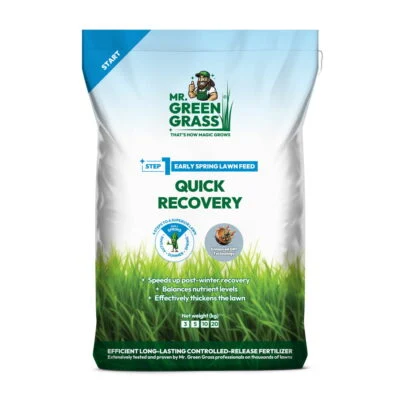
Early Spring Lawn Feed – Quick Recovery – Mr. Green Grass®
Original price was: £25,00.£12,45Current price is: £12,45.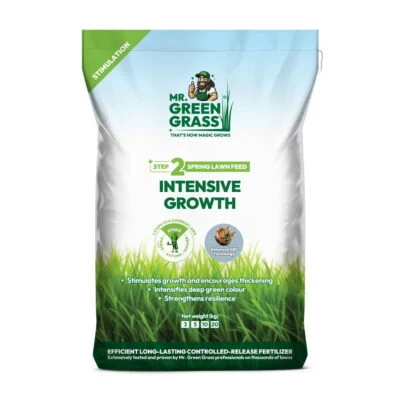
Spring Lawn Feed – Intensive Growth – Mr. Green Grass®
Original price was: £25,00.£12,45Current price is: £12,45.
Summer Lawn Feed – Complete Protection – Mr. Green Grass®
Original price was: £25,00.£12,45Current price is: £12,45.
Autumn Lawn Feed – Winter Survival – Mr. Green Grass®
Original price was: £25,00.£12,45Current price is: £12,45.Step I: Early Spring
The first fertilisation should be carried out in early spring, ideally between March and April. The ground should be thawed, and the lawn mown and cleared of any debris like leaves or sticks remaining after winter. If the lawn is in poor condition due to a developed layer of thatch, it should undergo aeration and scarification. For the first application, it is advisable to use a product rich in nitrogen to stimulate grass growth. It is also worth choosing potassium, which will positively affect the rooting of grass weakened after the winter months.
Step II: early summer
It is worth carrying out the next treatment in June or early July. During summer fertilising, remember not to do this during drought, heatwaves or after rain. This is the last call to use products rich in nitrogen! However, if your lawn is lush green and exuberant, it is worth placing emphasis on its slow growth as well as root development and grass density. For this purpose, you can use products rich in iron and potassium.
Step III: late summer
The turn of August and September is a time when we slowly begin to think about the approaching winter. Therefore, you should not use nitrogen fertilisers that cause intensive grass growth. Instead, it is worth opting for products rich in phosphorus, magnesium and potassium, which strengthen the grass’s resistance and improve its colour. During this time, it is worth observing the lawn for any developing moss, as this problem often appears after a warm and humid period.
Step IV: autumn
October is the time when you should protect your lawn before winter. For this reason, we apply products with increased amounts of potassium and phosphorus, as well as iron or copper. These ingredients are essential for the development of a strong root system and also support tillering. This ensures the lawn will be strong and dense, helping it survive the winter. At the same time, it will gain greater resistance to frosts, drought, and snow mould.
How to apply lawn feed?
Since we already know what and when, all that remains is to find out how lawn fertilisation should be carried out! There are several universal rules important at every step of proper lawn feed application.
- Firstly, you should always fertilise a mown lawn which is free from any organic debris, such as leaves, grass clippings or sticks.
- Fertilisers should not be measured “by eye”. In this way, you will not provide the optimum amount of needed nutrients, so the whole treatment will miss the point.
- It is best to apply lawn feed on a cloudy day when the lawn is not heated by the sun. Fertilisers spread during a drought or in full sun can scorch the grass.
- Fertilised grass should be dry. Fertiliser granules may stick to damp blades instead of penetrating the soil.
- It is worth fertilising before forecast rain. In this way, the nutrients will wash into the soil, reaching the grass roots more quickly. If rain is not expected, the lawn should be watered after the treatment.
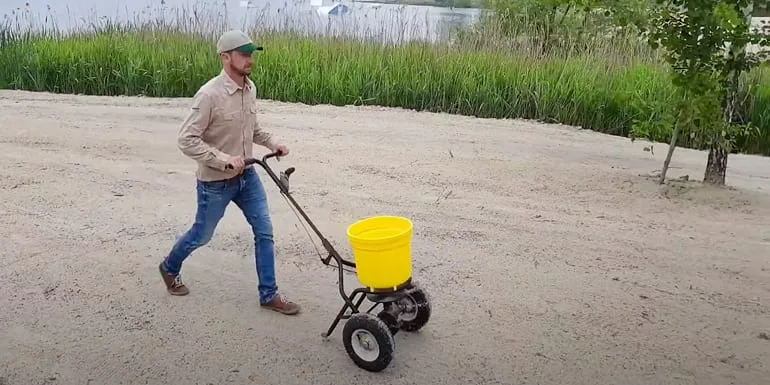
- Trawnika nie należy nawozić z ręki! Jest to bardzo niedokładna metoda aplikacji nawozów, ponieważ tworzy pasy trawy przenawożonej i takiej, do której preparat nie dotarł. Najlepszym sposobem jest skorzystanie z siewnika rotacyjnego, który równomiernie rozdysponuje produkt na cały trawnik.
- Mineral fertilisers should be stored in a dry place, as they are characterised by high moisture absorption. Contact with even a small amount of water can lead to clumping of the mix, making it unfit for use!